

Water Tank Cooling Face-Off Solar Water Tank Fan vs. Traditional Evaporative Cooler
Water Tank Cooling Face-Off: Solar Water Tank Fan vs. Traditional Evaporative Cooler
When your water tank overheats, finding an effective cooling solution is crucial. Many customers initially consider traditional evaporative cooling fans due to their seemingly straightforward "water-cooling" concept and often lower upfront cost.
However, the right choice depends on understanding how each technology works and whether it fits your specific environment. Let's dive into a detailed comparison between the Traditional Evaporative Cooler and our Smart Solar Water Tank Fan to see which delivers true long-term value and reliability.

Core Technology Breakdown: Two Different Paths to Cooling
|
Aspect |
Traditional Evaporative Cooling Fan |
SIPL Solar Water Tank Fan |
|
Working Principle |
Evaporative Cooling. A pump wets a cellulose pad. A fan draws outside air through this wet pad, and the evaporation of water cools the air, which is then blown into the tank. |
Forced Air Exchange. Directly extracts the hot, moisture-saturated air trapped at the top of the tank while drawing in cooler, drier ambient air from outside through lower vents. |
|
What It Cools |
Cools the incoming air before it enters the tank. |
Cools the internal environment of the tank by reducing both temperature and humidity. |
|
Key Dependency |
Heavily reliant on a water supply and low humidity. Requires continuous water (risk of pump failure, scaling). Efficiency plummets in humid climates and is ineffective during rainy seasons or at night when pads are dry. |
Relies only on solar power and temperature differential. Needs no water. Operates via smart thermostat whenever the outside air is cooler than the inside, effective in most climates. |
|
Energy Consumption |
Dual Consumption. Requires electricity to run both a water pump and a high-power fan, leading to significant ongoing costs. |
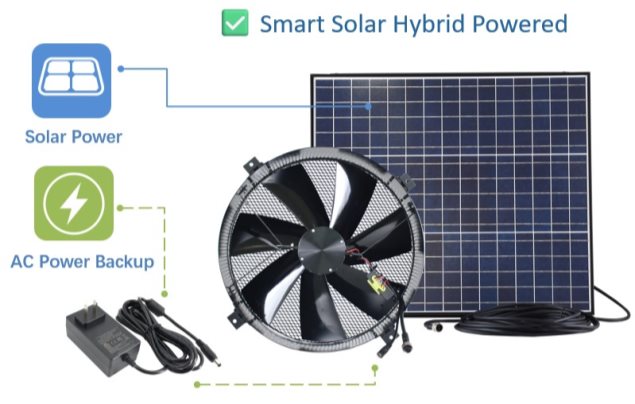
Single, Ultra-Low Consumption. Powers only one efficient fan using 100% solar energy, resulting in zero electricity bills. |
|
Water Quality Risk |
Potential Contamination Risk. Stagnant water in the system can breed bacteria and algae, which may be carried into the tank. Pads require frequent cleaning/replacement. |
Physically Isolated, Zero Contact. Only deals with air exchange. No introduction of untreated external water, ensuring better water safety. |
Comprehensive Benefit Comparison: The Smarter Long-Term Investment
|
Factor |
Traditional Evaporative Cooler |
SIPL Solar Water Tank Fan |
What It Means for You |
|
Initial Investment |
Lower equipment purchase price typically. |
Higher equipment purchase price. |
Traditional option seems "cheaper" at first glance. |
|
Long-Term Operational Cost |
High. Continuous costs for water & electricity, plus regular pad replacement and pump maintenance add up. |
Virtually Zero. No utility bills and minimal maintenance. |
The solar solution often pays back the price difference within 1-2 years through savings, then generates pure savings. |
|
Cooling Performance & Reliability |
Highly Unstable. Effectiveness is dictated by ambient humidity. Nearly useless in humid weather or at night. |
Stable & Reliable. Works whenever a temperature differential exists, unaffected by humidity. Provides consistent protection. |
Solar offers predictable, uninterrupted performance, while the traditional unit may fail when you need it most. |
|
Maintenance & Durability |
High Maintenance. Pumps are prone to failure, pads clog and breed mold, mineral scale builds up. Requires frequent cleaning, part replacement, and repairs. |
Low Maintenance. No moving parts in contact with water, simple and robust design. |
The solar option drastically reduces downtime, labor costs, and recurring expenses. |
|
Installation & Applicability |
Requires connection to both a water line and the electrical grid. Installation is more complex. |
Extremely Simple Installation. Needs only sunlight. No plumbing or electrical wiring needed. Ideal for rooftops, remote areas, and locations without a stable water supply. |
The solar solution offers far greater flexibility and applicability, removing infrastructure barriers. |
|
Environmental Impact |
Continuously consumes water and grid electricity. |
100% green energy, zero operational carbon footprint. |
Choosing solar is a direct investment in sustainability and corporate responsibility. |
Conclusion: Embracing a Smarter, Sustainable Future for Water Tank Management
Choosing the right cooling solution is a critical decision that impacts not only your immediate budget but also your long-term operational efficiency, water safety, and environmental footprint. While a traditional evaporative cooler may appear to be a low-cost entry point, its hidden expenses—soaring energy bills, constant water usage, frequent maintenance, and unreliable performance in humidity—quickly add up, turning an initially "cheap" option into a costly burden.
Our Solar Water Tank Fan represents a fundamental shift in approach. It is not merely a product, but a long-term investment in reliability, sustainability, and simplicity. By harnessing free solar energy to drive intelligent, moisture-independent ventilation, it solves the core problem of heat buildup without creating new ones. The result is consistent protection for your water supply, significant reductions in operational costs, and the peace of mind that comes with a robust, "set-and-forget" system.

We Understand Your Concerns. Let Us Show You the Value.
We know that upfront investment matters. That’s why we encourage you to think beyond the initial price tag. Consider the total cost of ownership over 5 or 10 years. Consider the value of guaranteed performance during the hottest, most humid months. Consider the benefit of zero electrical wiring and no water connection complications. When you add it all up, the choice becomes clear.
Ready to make a change that pays for itself?
Contact our team today for a no-obligation consultation. Let us help you transition to a cooler, more efficient, and cost-effective water storage system.


-
How Can Solar Powered Vent Fans Improve Your Home Cooling
넶55 2026-07-17 -
-

-
-
-